Guides
How many guests will really fit
A venue’s posted capacity is only a starting point. What will really fit depends on your layout, service style, dance floor, stage, and how much breathing room the two of you want for your guests.

The short answer
A room that "holds 150" does not always feel good with 150 wedding guests. That number may assume a very specific setup, such as tight banquet tables, no large sweetheart table, no live band, and a small or shared dance floor.
For many weddings, the comfortable number ends up lower than the maximum listed capacity. A good rule is to ask each venue for the capacity for your exact setup: seated dinner, buffet or plated meal, dance floor, DJ or band, ceremony in the same room, and any special elements from your traditions or faith.
If you are still building your guest list, it helps to think in ranges. For example, if you expect 110 to 130 guests, a venue that says "up to 120" may feel risky, while one that fits 150 in your preferred layout may give you more room to breathe.
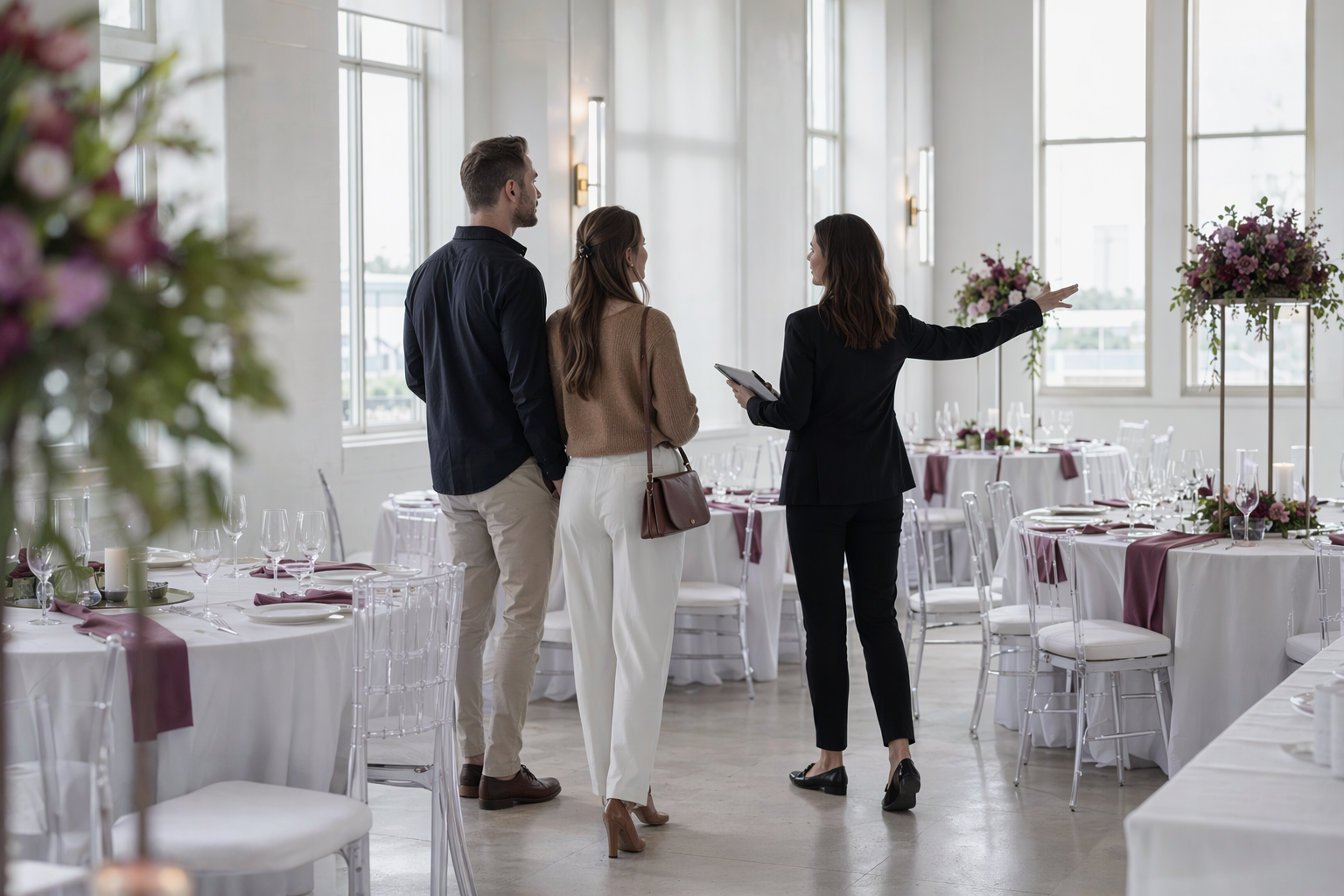
Why the real number changes
Capacity changes because weddings are not all set up the same way. Round tables usually take more room than rows of ceremony chairs. A plated dinner may fit differently than buffet lines. A large dance floor, photo booth, stage, lounge furniture, dessert display, or kids' area can reduce the number of guests a room can hold comfortably.
Your guest mix matters too. Two hundred guests at mostly 8-top rounds feels different from long family-style tables. If many guests use mobility devices, strollers, or need easier pathways, you may want wider aisles and more space between tables. If your celebration includes a tea ceremony, hora, baraat arrival, altar, mandap, chuppah, kneeling benches, or other meaningful setup pieces, those also affect fit.
Indoor-outdoor weddings can be tricky. A venue may quote one number if the patio is open and another if weather pushes everyone inside. Always ask what fits if it rains, if it is too hot, or if part of the space becomes unavailable.
What to ask the venue before you fall in love with the space
Ask for the capacity for your exact event, not just the highest number on a brochure. It is completely reasonable to ask for a sample floor plan with your rough guest count and setup.
Here are the most useful questions to ask:
- What is the maximum for a seated dinner with a dance floor?
- What is the maximum for a ceremony and reception in the same room?
- Is that number a legal/fire-code maximum, or a comfortable wedding maximum?
- Can you show us a sample layout for our guest count?
- How many guests fit with round tables versus long tables?
- Where would the DJ or band go, and how much space do they need?
- If weather changes our plan, how many people fit indoors?
- Are there restrictions on aisle width, exits, wheelchair access, or stroller access?
- Are children counted in the capacity?
- Do buffet tables, bars, dessert stations, or cultural ceremony areas reduce the guest count?
Before paying a deposit or signing, ask the venue to confirm your date, your expected guest range, and the setup they are pricing in writing. Then read the full contract carefully. This is general information only, not legal or financial advice.
Red flags and fine print to watch for
Be careful if a venue keeps repeating one big capacity number but will not say how many fit for your actual layout. That can be a sign the room only reaches that number under a stripped-down setup that may not match your day.
Another red flag is when the room technically fits your guest count, but the floor plan leaves very tight aisles, blocked views, crowded buffet lines, or almost no dance floor. A packed room can affect comfort, service speed, and the overall feeling of the celebration.
Also watch the contract language around room flips, rain plans, and minimum guest counts. Some venues can host your ceremony and reception in the same space, but the room flip takes time and may change what fits. Ask whether the final table count, dance floor, vendor setup, bars, and staging are included in the capacity they promised.
And remember: price and fit are connected. A bigger room may cost more, but an undersized room can create stress, extra rentals, or a layout you do not love.
How guest count affects cost
Guest count changes more than the room size. It can affect the site fee, food-and-beverage minimum, per-person meal cost, bar cost, rentals, staffing, valet, security, and whether you need a larger tent, more restrooms, or extra shuttles. That is why two venues that both "fit 150" can have very different all-in totals.
As a very general example, a venue for around 75 to 125 guests might have a site fee from about $2,000 to $8,000 in some markets, while larger or more in-demand spaces can be $8,000 to $20,000 or more. Food and beverage may add roughly $40 to $200+ per guest depending on the city, season, service style, and what is included. These are broad ranges, not quotes.
The real number depends on the date, season, day of week, city, guest count, and what is included. Saturday evenings in peak season usually cost more than Fridays, Sundays, brunches, winter dates, or off-peak months. A venue that looks cheaper at first may still have a food-and-beverage minimum, service charges, rental fees, overtime, corkage, or vendor restrictions.
When you compare options, ask for the estimated all-in cost for your guest range and layout. Confirm the site fee, food-and-beverage minimum, per-plate pricing, deposit, overtime, cancellation terms, vendor rules, and any required rentals in writing. You can read more in costs and explore other planning help in our guides.
A simple way to choose the right size venue
If you are between two guest counts, choose a venue that works well for your expected number, not just your dream maximum. A room that feels warm and comfortable with 110 guests is often better than a huge space that only feels full if 180 come.
Try this simple process:
- Build an "A list" of the people you truly expect to invite.
- Estimate a realistic range, like 90 to 110 or 140 to 170.
- Decide what must fit: ceremony, dinner, dance floor, band or DJ, cultural elements, kids' space, lounge, photo booth.
- Ask each venue for a floor plan for that exact range and setup.
- Compare the all-in cost, not just the headline rental price.
- Confirm your date and setup details in writing before you pay a deposit.
If the two of you want help finding places that fit your guest range, style, and budget comfort level, Vowfield can help. We are a free matching service, not a wedding venue or planner. You share basic contact and wedding details, and we help you get matched with venues near you to tour and compare. You can start at get matched or browse more quick answers in help.
A venue’s listed capacity is not the same as what will comfortably fit your wedding, so ask for your exact layout and total cost in writing before you book.
Common questions
Is venue capacity the same as the number of wedding guests that will fit comfortably?
Usually no. The posted number may be a maximum under a specific setup, and your comfortable guest count may be lower once you add tables, a dance floor, buffet, stage, or ceremony pieces.
Should we leave extra room if we are inviting older guests, children, or guests using mobility devices?
Yes, that is often wise. Wider aisles, easier access, stroller space, and comfortable table spacing can make the day feel much better for everyone.
Can a venue fit more people for a ceremony than for a reception?
Often yes. Rows of ceremony chairs usually fit more people than dinner tables, bars, buffet stations, and a dance floor.
What if our final RSVP count changes after we book?
Ask the venue how flexible the room is and what happens if your count goes up or down. Check the contract for guest minimums, maximums, room changes, and any pricing changes before you sign.
Does Vowfield tell us exactly how many guests a venue can hold?
No. Vowfield is a free matching service, not a venue or wedding planner. We can help you get matched with venues to tour and compare, but each venue must confirm its own capacity, layout, date availability, and pricing in writing.